
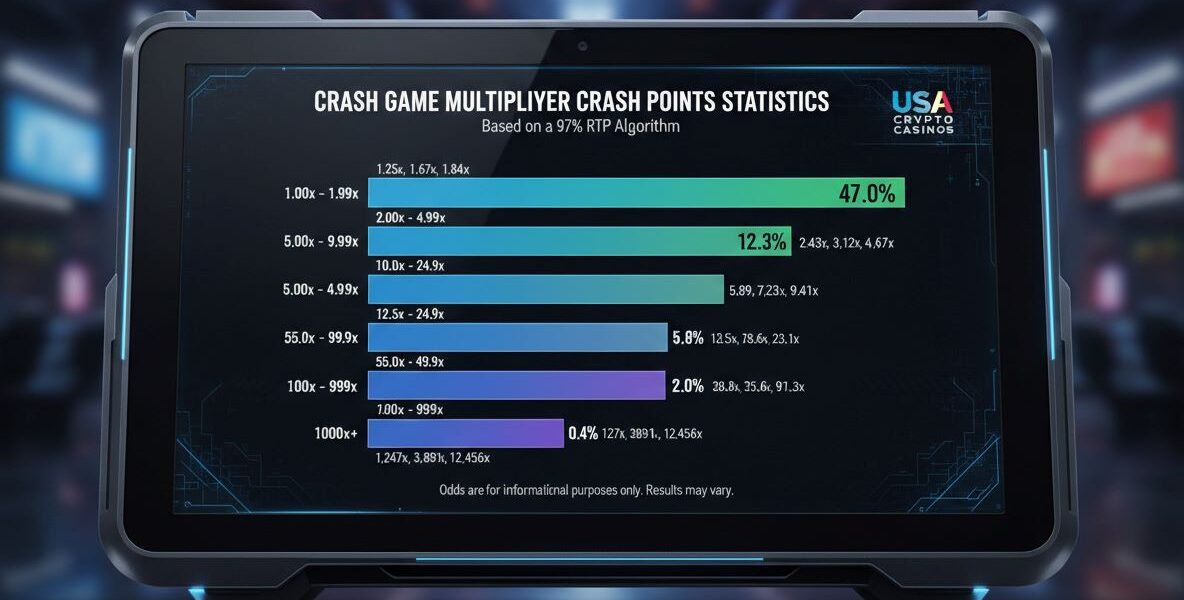
Crash Game Multiplier Crash Points Statistics
Crash games have exploded in popularity across USA crypto casinos, captivating players with their simple yet thrilling multiplier mechanics. These instant-action games feature a rising multiplier that can crash at any moment, challenging players to cash out before the inevitable crash point arrives. With a standard 97% RTP built into the algorithm, crash games offer transparent odds that players can analyze and understand.
The statistics behind crash game multipliers reveal fascinating patterns that USA players should understand before placing their bets. Approximately 50% of all rounds crash before reaching the 2x multiplier, while only 10% survive beyond 10x. These probabilities are governed by sophisticated random number generation systems that ensure fairness while maintaining the house edge that keeps crypto casinos profitable.
Core Mechanics of Crash Game Multipliers
Crash game multipliers operate on a geometric distribution model that determines when each round will end. The algorithm uses a 3% house edge calculation, meaning there’s always a 3% chance of an instant crash at 1.00x before the multiplier even begins to rise. This mathematical foundation ensures that USA crypto casinos maintain their edge while providing players with genuinely random outcomes.
The random number generation mechanisms behind crash games utilize cryptographic hash functions to produce unpredictable results. USA-focused platforms emphasize provably fair technology, allowing players to verify that each round’s outcome was predetermined and not manipulated. This transparency has become a cornerstone of legitimate crash game operations in the American crypto gambling market.
Understanding these core mechanics helps players appreciate why crash games maintain their 97% RTP across millions of rounds. The geometric distribution ensures that while some multipliers reach extraordinary heights, the majority crash at lower levels, creating the perfect balance of excitement and mathematical probability that defines this gaming category.
How Crash Points Are Generated
The multiplier formula in crash games uses the equation: Crash Point = 1 / (1 – R), where R represents a random number between 0 and 0.97. This mathematical relationship ensures that approximately 50% of games crash before 2x, 10% crash before 1.1x, and less than 1% reach 100x or higher multipliers.
Example probabilities demonstrate this distribution clearly: a 2x multiplier has a 50% survival rate, 5x has a 19.4% chance, and 10x drops to just 9.7%. These probabilities remain constant for every single round, regardless of previous outcomes or apparent patterns that players might perceive during their gaming sessions.
RTP and House Edge in USA Crash Games
The relationship between multiplier targets and house edge percentages varies significantly based on player cashout strategies. Understanding these dynamics helps USA players make informed decisions about their risk tolerance and potential returns when engaging with crash game multipliers.
| Multiplier Target | Crash Probability <=x | House Edge % | Expected Loss per $1 |
|---|---|---|---|
| 2.00x | 50.0% | 3.0% | $0.03 |
| 5.00x | 80.6% | 3.0% | $0.03 |
| 10.0x | 90.3% | 3.0% | $0.03 |
| 25.0x | 96.1% | 3.0% | $0.03 |
| 100x | 99.0% | 3.0% | $0.03 |
Crash Point Probability Statistics
Crash point probability statistics reveal the mathematical foundation underlying every multiplier outcome in crash games. The cumulative probability distribution shows how frequently different multiplier ranges occur across thousands of rounds, providing USA players with concrete data to inform their gaming strategies and risk management decisions.
| Multiplier | P(Crash <=x) | Cumulative % | Frequency in 1000 Rounds |
|---|---|---|---|
| 1.00x | 3.0% | 3.0% | 30 |
| 1.50x | 35.3% | 35.3% | 353 |
| 2.00x | 50.0% | 50.0% | 500 |
| 3.00x | 68.0% | 68.0% | 680 |
| 5.00x | 80.6% | 80.6% | 806 |
| 10.0x | 90.3% | 90.3% | 903 |
| 25.0x | 96.1% | 96.1% | 961 |
| 50.0x | 98.1% | 98.1% | 981 |
| 100x | 99.0% | 99.0% | 990 |
Visualizing Crash Distributions
The dominance of low multipliers becomes immediately apparent when examining crash distribution data across extended gaming sessions. Nearly 70% of all crash points occur below the 3x multiplier, while extreme multipliers above 100x appear less than once per thousand rounds on average.
This probability spread creates the characteristic tension that defines crash gameplay – while massive multipliers are theoretically possible, the mathematical reality strongly favors lower crash points. USA players who understand this distribution can develop more realistic expectations and avoid the common trap of chasing rare high-multiplier outcomes that occur with minimal frequency.
Expected Value Calculations for Strategies
Expected value calculations form the mathematical backbone of effective crash game strategy, providing USA players with quantifiable metrics to evaluate different approaches. The EV formula combines the probability of winning at specific multipliers with potential payouts: EV = (Probability of Success × Payout) – (Probability of Loss × Bet Amount). This calculation reveals that all strategies converge on the same negative expected value over time, reflecting the consistent 3% house edge.
Different multiplier targets offer varying risk-reward profiles, but none can overcome the mathematical disadvantage built into crash game algorithms. Conservative strategies targeting 2x multipliers provide frequent wins but smaller payouts, while aggressive approaches aiming for 10x or higher offer substantial rewards but suffer from low success rates. Understanding these trade-offs helps players align their strategies with personal risk tolerance and bankroll management goals.
The pros and cons of various EV approaches become clearer when examined through long-term performance data. Short-term variance can create winning streaks or losing runs that mask the underlying mathematical realities, making it essential for USA players to focus on expected value rather than recent results when evaluating their crash game strategies.
Low vs High Multiplier EV
Comparing expected values across different cashout multipliers demonstrates how mathematical principles govern long-term outcomes regardless of strategy selection. While the house edge remains constant at 3%, the volatility and frequency of wins varies dramatically between conservative and aggressive approaches.
| Cashout x | P(Win) | EV per $1 | Long-term Loss % |
|---|---|---|---|
| 1.50x | 64.7% | $0.97 | 3.0% |
| 2.00x | 50.0% | $0.97 | 3.0% |
| 5.00x | 19.4% | $0.97 | 3.0% |
| 10.0x | 9.7% | $0.97 | 3.0% |
| 25.0x | 3.9% | $0.97 | 3.0% |
Martingale Strategy Breakdown
The Martingale strategy in crash games involves doubling bet sizes after losses, aiming to recover previous losses with a single win. While this approach can work short-term, it carries significant risks that USA players should carefully consider before implementation.
- Advantage: Guarantees profit recovery with eventual wins at conservative multipliers like 1.5x or 2x
- Advantage: Simple to implement and understand without complex calculations or timing requirements
- Risk: Requires exponentially increasing bet sizes that can quickly exhaust bankrolls during losing streaks
- Risk: Table limits at crypto casinos can prevent bet doubling after several consecutive losses
- Risk: The 3% instant crash probability means even 1.01x targets aren’t guaranteed winners
- Risk: Psychological pressure intensifies as bet sizes grow, leading to poor decision-making under stress
USA-Specific Crash Game Trends
The American crash game market has experienced remarkable growth as crypto casinos adapt their offerings to appeal to USA players seeking fast-paced, skill-influenced gaming experiences. These trends reflect broader shifts in American gambling preferences toward transparency and mathematical verifiability.
- Integration with popular cryptocurrency wallets and USA-friendly payment processors for seamless deposits and withdrawals
- Mobile-optimized crash game interfaces designed for smartphone gaming during commutes and breaks
- Live chat features connecting USA players in real-time social gaming environments
- Provably fair verification tools prominently displayed to address American concerns about game integrity
- Tournament formats and leaderboard competitions appealing to competitive USA gaming culture
- Educational content specifically addressing American players’ questions about RTP and house edge calculations
- Integration with streaming platforms where USA influencers demonstrate crash game strategies and outcomes
Popular Crash Games in USA
Leading crash game platforms in the USA market include Aviator, which maintains the standard 97% RTP while offering enhanced graphics and social features. Crash X and Spaceman have also gained traction among American players, each providing unique visual themes while maintaining identical mathematical foundations and probability distributions.
These platforms distinguish themselves through user experience enhancements rather than altered RTPs or probability structures. USA players benefit from English-language customer support, dollar-denominated betting options, and compliance with emerging regulatory frameworks that prioritize transparency and player protection in the evolving crypto gambling landscape.
Multiplier Patterns and Predictor Myths
Multiplier randomness in crash games stems from cryptographic algorithms that generate truly unpredictable outcomes, yet many USA players fall prey to pattern recognition fallacies that suggest predictability where none exists. Each crash point is mathematically independent of previous results, making it impossible to forecast future multipliers based on historical sequences or apparent trends.
Predictor tools and software claiming to anticipate crash points exploit cognitive biases rather than mathematical realities. These applications often display sophisticated interfaces and complex calculations that create an illusion of scientific validity, but they cannot overcome the fundamental randomness built into crash game algorithms. USA players should understand that no legitimate mathematical approach can predict future crash points with accuracy exceeding random chance.
The persistence of predictor myths reflects human psychology more than mathematical possibility. Players naturally seek patterns and control in random environments, making them vulnerable to systems and strategies that promise order amid chaos. Recognizing these psychological tendencies helps American crash game enthusiasts maintain realistic expectations and avoid costly mistakes based on false predictive claims.
Common Pattern Fallacies
- Hot streaks myth: Believing that recent high multipliers indicate continued favorable outcomes
- Cold streak fallacy: Assuming that a series of low crashes must be followed by higher multipliers
- Time-based patterns: Thinking that multipliers follow daily, hourly, or session-based cycles
- Player count influence: Believing that the number of active players affects crash point generation
- Bet size correlation: Assuming that larger or smaller bets influence subsequent multiplier outcomes
- Manual vs auto-cashout impact: Thinking that cashout method affects future crash point probabilities
Provably Fair Verification
Provably fair systems in USA crash games utilize SHA-256 hashing algorithms combined with client and server seeds to generate verifiable random outcomes. Players can independently verify that each crash point was predetermined before the round began, eliminating concerns about real-time manipulation or biased results favoring the house.
The verification process involves combining encrypted server seeds with player-influenced client seeds, creating a hash that determines the specific crash point through mathematical transformation. USA crypto casinos provide detailed explanations and verification tools, allowing players to confirm fairness manually or through automated checking systems that validate thousands of rounds simultaneously.
Optimal Cashout Strategies
Optimal cashout strategies in crash games must balance risk tolerance with mathematical realities, recognizing that no approach can overcome the built-in house edge over extended play. USA players benefit from understanding how different strategies perform across various risk levels and time horizons.
| Strategy | Target x | Risk Level | Est. RTP |
|---|---|---|---|
| Ultra Conservative | 1.25x | Very Low | 97% |
| Conservative | 2.00x | Low | 97% |
| Moderate | 3.50x | Medium | 97% |
| Aggressive | 7.50x | High | 97% |
| High Risk | 15.0x | Very High | 97% |
| Extreme Risk | 50.0x | Extreme | 97% |
Safe Betting Approaches
Safe betting in crash games requires strict bankroll management combined with realistic expectations about long-term outcomes. USA players should never wager amounts they cannot afford to lose completely, recognizing that even conservative strategies carry inherent risks due to the random nature of crash points and the mathematical house advantage.
Establishing preset loss limits and win goals before beginning play sessions helps maintain discipline when emotions run high during winning streaks or losing runs. The most successful USA crash game players treat their activity as entertainment rather than investment, maintaining perspective about the probabilistic nature of all outcomes regardless of short-term results or apparent patterns.
Historical Data Insights
Historical crash data analysis reveals consistent patterns that validate the mathematical models underlying crash game algorithms. Across millions of rounds from USA crypto casinos, the distribution of crash points adheres closely to theoretical predictions, with slight variations attributable to random sampling rather than systematic bias or manipulation.
Volatility metrics from extensive historical datasets demonstrate the extreme variance inherent in crash game outcomes. While average returns cluster around the expected 97% RTP, individual sessions can deviate dramatically from this mean, with some players experiencing significant wins or losses over short time periods. Understanding this volatility helps USA players maintain appropriate expectations and avoid overreacting to temporary results.
Long-term data analysis confirms that no betting strategy or pattern recognition approach has successfully overcome the mathematical house edge across sustained periods. Players who achieve temporary success often attribute their results to skill or system effectiveness, but extended data reveals the dominant influence of random variance rather than strategic superiority in determining outcomes.
Crash Frequency Table
Breaking crash points into ranges provides USA players with practical insights into frequency distributions across different multiplier categories. This data helps inform strategic decisions about target multipliers and expected waiting times for specific outcomes.
| Range | % Crashes | Example Multipliers |
|---|---|---|
| 1.00x – 1.99x | 47.0% | 1.25x, 1.67x, 1.84x |
| 2.00x – 4.99x | 30.6% | 2.43x, 3.12x, 4.67x |
| 5.00x – 9.99x | 12.3% | 5.89x, 7.23x, 9.41x |
| 10.0x – 24.9x | 5.8% | 12.5x, 18.7x, 23.1x |
| 25.0x – 49.9x | 2.0% | 28.4x, 35.6x, 47.2x |
| 50.0x – 99.9x | 1.0% | 56.8x, 73.9x, 91.3x |
| 100x – 999x | 0.9% | 127x, 284x, 567x |
| 1000x+ | 0.4% | 1,247x, 3,891x, 12,456x |
Volatility Metrics
High variance characteristics make crash games particularly engaging for USA players seeking adrenaline-fueled gaming experiences, but this same volatility creates significant risks for those unprepared for dramatic bankroll swings. Standard deviation calculations reveal that individual session outcomes can vary by 300-500% from expected values, even across hundreds of rounds.
Risk metrics demonstrate why crash games appeal to different player psychology compared to traditional casino offerings. The combination of transparency, skill elements in timing decisions, and extreme variance creates a unique gaming environment where mathematical understanding becomes crucial for managing expectations and maintaining appropriate bankroll discipline throughout extended play sessions.
Risks and Responsible Play
Responsible crash game participation requires USA players to acknowledge both the mathematical disadvantage inherent in all casino games and the psychological risks associated with high-variance gambling activities. The combination of rapid-fire rounds, social features, and potential for large multipliers can trigger addictive behaviors in vulnerable individuals, making self-awareness and preset limits essential for safe participation.
Addiction risks increase when players chase losses, escalate bet sizes beyond their means, or begin viewing crash games as investment opportunities rather than entertainment expenses. USA players should establish strict time and money limits before beginning play sessions, never borrowing funds to gamble, and seeking professional help if gaming begins negatively impacting personal relationships, work performance, or financial stability.
Key Takeaways for USA Players
- Set strict loss limits before playing and never exceed predetermined bankroll allocations regardless of short-term outcomes
- Understand that no strategy can overcome the 3% house edge, making long-term losses mathematically inevitable for all players
- Recognize that crash games are entertainment expenses, not investment opportunities or income-generation methods
- Verify game fairness using provably fair tools, but remember that fairness doesn’t eliminate the mathematical house advantage
- Seek immediate help from gambling addiction resources if crash gaming begins causing personal, professional, or financial problems