
Roulette Double Zero House Edge Explained
American roulette’s brutal 5.26% house edge stems directly from its 38-pocket wheel layout, featuring both 0 and 00 alongside numbers 1-36. This seemingly small addition of one extra zero pocket nearly doubles the casino’s advantage compared to European roulette’s modest 2.7% edge. The mathematics behind this difference reveal how significantly that second zero impacts your bankroll over time, turning what appears to be a minor variation into a major factor in long-term losses.
The house edge represents the casino’s built-in advantage, meaning American roulette delivers a return to player (RTP) of just 94.74%. For every $100 wagered, players can expect to lose $5.26 on average, making bankroll management absolutely critical for anyone choosing to play this popular but mathematically challenging variant.
What Is House Edge in Roulette?
House edge represents the mathematical advantage casinos maintain over players, expressed as a percentage of each bet. In American roulette, this 5.26% edge means you lose $5.26 for every $100 wagered over the long term, resulting in a 94.74% return to player rate. Consider a simple $1 red or black bet: while you have 18 ways to win, the presence of both 0 and 00 creates 20 ways to lose out of 38 total outcomes.
This percentage reflects the difference between true odds and casino payouts. Even though red and black cover 18 numbers each, the casino pays even money (1:1) rather than the true odds of 20:18, creating their mathematical edge. Understanding this concept helps explain why casinos can offer entertaining games while maintaining profitable operations.
The house edge applies to every spin independently, meaning short-term results can vary wildly from the mathematical expectation. However, as the number of spins increases, actual results converge toward the theoretical edge, making it a reliable predictor of long-term outcomes.
House Edge Formula Basics
The basic house edge formula for roulette calculates as (number of zero pockets ÷ total pockets) × 100%. American roulette’s two zeros among 38 total pockets create a 2/38 = 5.26% house edge. European roulette’s single zero among 37 pockets yields 1/37 = 2.70%, demonstrating how dramatically that extra zero impacts the odds.
This formula applies universally across most roulette bets because payouts are structured around the 36 non-zero numbers, while the zeros create the casino’s advantage. The mathematical elegance lies in its simplicity: more zeros equal higher house edge, regardless of betting strategy or patterns.
Why It Matters Long-Term
Over 1000 spins wagering $100 per spin, the 5.26% house edge predicts total losses of $5,260 in American roulette versus $2,700 in European roulette. This $2,560 difference illustrates why serious players prioritize single-zero tables when available. The edge compounds over time, making extended sessions particularly expensive at double-zero tables.
Short-term variance can mask the house edge’s impact, creating winning streaks that obscure the mathematical reality. However, the law of large numbers ensures that increased play volume brings actual results closer to theoretical expectations, making the house edge the most reliable predictor of long-term gambling outcomes.
American Roulette Wheel: Double Zero Explained
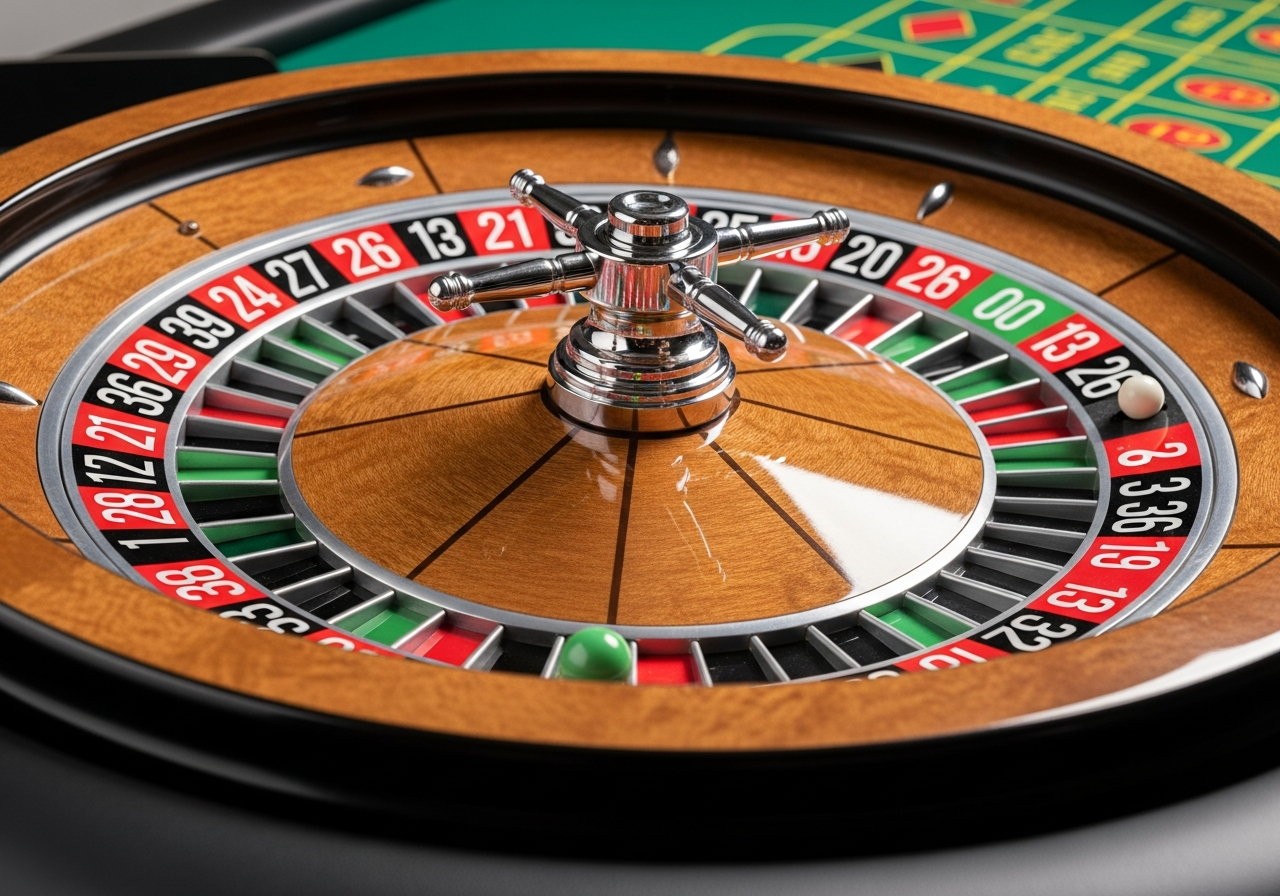
The American roulette wheel contains 38 pockets: single zero (0), double zero (00), and numbers 1-36. This configuration creates the 5.26% house edge because payouts are calculated based on 36 numbers, while players face 38 possible outcomes. The double zero doesn’t improve any bet’s payout structure—it simply adds another losing possibility for all wagers except those specifically including 00.
The wheel layout alternates red and black numbers in a specific pattern, with both zero pockets colored green to distinguish them from regular betting options. This visual design reinforces that zeros represent the house’s advantage, standing apart from the standard betting grid that forms the foundation of most roulette strategies.
Double Zero vs Single Zero Pockets
| Wheel Type | Total Pockets | Zero Pockets | House Edge |
|---|---|---|---|
| American | 38 | 2 (0, 00) | 5.26% |
| European | 37 | 1 (0) | 2.70% |
| Triple Zero | 39 | 3 (0, 00, 000) | 7.69% |
The comparison reveals how each additional zero pocket dramatically impacts the house edge. American roulette’s double zero creates nearly twice the disadvantage of European roulette, while the emerging triple zero variant pushes the house edge to an almost prohibitive 7.69%. These differences compound over time, making wheel selection one of the most important strategic decisions for roulette players.
How to Calculate 5.26% House Edge
The 5.26% calculation stems from the casino’s $2 profit advantage per complete $38 cycle. When all 38 numbers hit once, the casino collects $38 in losing bets but pays out only $36 in winnings (at even-money odds), creating a $2 net profit. Dividing this $2 profit by the $38 total wagered yields 5.26%. This mathematical relationship applies regardless of actual bet amounts or patterns.
Consider an even-money bet like red or black: you have 18 ways to win but 20 ways to lose (18 opposite color + 2 zeros). The true odds against you are 20:18 or 10:9, yet the casino pays only 1:1. This payout discrepancy creates the house edge, systematically favoring the casino on every spin.
The beauty of this calculation lies in its consistency across most bets. Whether you wager on single numbers, combinations, or even-money propositions, the underlying mathematics remain constant because payouts are structured around 36 numbers while the wheel contains 38 pockets.
Math Breakdown: 2/38 Formula
The fundamental calculation breaks down as (casino profit ÷ total risk) × 100 = house edge percentage. In American roulette, those two zero pockets represent the casino’s profit margin against the 38 total outcomes, creating the 2/38 = 0.0526 = 5.26% edge. This formula applies universally because every standard bet loses when either zero appears.
Understanding this ratio helps explain why the house edge remains constant regardless of betting patterns or progression systems. The mathematical relationship between profit and risk stays fixed at 2:38, making the house edge an inescapable feature of American roulette’s structure rather than something that can be overcome through clever betting strategies.
Practical $100 Bet Example
When you place $100 on any standard American roulette bet, the expected return is $94.74, representing a $5.26 average loss. This doesn’t mean you lose exactly $5.26 on each bet—short-term results vary dramatically. Instead, this figure represents the mathematical average across thousands of identical wagers.
The $94.74 return rate means American roulette keeps $5.26 of every $100 wagered over the long term. This predictable erosion of bankroll makes time management crucial, as extended play sessions virtually guarantee approaching the mathematical expectation regardless of short-term fluctuations or betting strategies employed.
House Edge by Bet Type in American Roulette
| Bet Type | Payout | House Edge | RTP |
|---|---|---|---|
| Straight Up | 35:1 | 5.26% | 94.74% |
| Split | 17:1 | 5.26% | 94.74% |
| Street | 11:1 | 5.26% | 94.74% |
| Corner | 8:1 | 5.26% | 94.74% |
| Five Number | 6:1 | 7.89% | 92.11% |
| Line | 5:1 | 5.26% | 94.74% |
| Column/Dozen | 2:1 | 5.26% | 94.74% |
| Even Money | 1:1 | 5.26% | 94.74% |
Worst Bet: Five Number (0-00-1-2-3)
The five-number bet covering 0-00-1-2-3 carries a devastating 7.89% house edge, making it the worst wager in American roulette. This bet pays 6:1 on five numbers, but true odds are 33:5 (6.6:1), creating a larger gap between fair odds and actual payouts than any other roulette bet. The additional 2.63% house edge compared to standard bets represents a 50% increase in the casino’s mathematical advantage.
Smart players avoid this bet entirely, as no strategic or entertainment value justifies accepting worse odds. The five-number bet serves as a trap for uninformed players, offering seemingly attractive 6:1 odds while delivering the poorest return rate available on the American roulette layout.
American vs European Roulette Comparison
| Aspect | American (Double Zero) | European (Single Zero) | Advantage |
|---|---|---|---|
| House Edge | 5.26% | 2.70% | European |
| RTP | 94.74% | 97.30% | European |
| Total Pockets | 38 | 37 | European |
| Even Money Edge with La Partage | 5.26% | 1.35% | European |
The comparison reveals European roulette’s substantial mathematical advantage over American roulette. The 2.56% difference in house edge translates to significantly reduced losses over time, with European roulette’s 97.30% RTP providing much better value than American roulette’s 94.74% return rate. When European tables offer La Partage rules, even-money bets face only a 1.35% house edge, making American roulette nearly four times more expensive for these popular wagers.
Long-Term Impact Table
| Bets Placed | American Loss ($100 bet) | European Loss ($100 bet) | Difference |
|---|---|---|---|
| 100 spins | $526 | $270 | $256 |
| 500 spins | $2,630 | $1,350 | $1,280 |
| 1000 spins | $5,260 | $2,700 | $2,560 |
La Partage Rule in European
La Partage rules in European roulette return half of even-money bets when zero hits, reducing the effective house edge to just 1.35% on red/black, odd/even, and high/low wagers. This rule makes European roulette with La Partage nearly four times more favorable than American roulette for these popular betting options, representing one of the best odds available in casino gambling.
Triple Zero Roulette: Even Worse Odds
Triple zero roulette adds a third zero (000) to create 39 total pockets, pushing the house edge to a crushing 7.69%. This represents a 46% increase over American roulette’s already unfavorable 5.26% edge and nearly tripled the 2.70% edge found in European roulette. The additional zero provides no benefit to players while dramatically accelerating bankroll depletion through increased mathematical disadvantage.
Casino operators introduced triple zero tables to boost profits, particularly in high-traffic tourist areas where players may not recognize the odds difference. The 7.69% house edge approaches the levels found in some slot machines, making triple zero roulette one of the worst odds in table gaming. Smart players avoid these tables entirely, as no entertainment value justifies accepting such poor mathematical prospects.
Avoid Triple Zero Tables
- House edge increases to 7.69%, representing 46% worse odds than standard American roulette
- Bankroll depletion accelerates significantly due to the higher mathematical disadvantage
- No improved payouts or player benefits compensate for the additional zero pocket
- Often marketed deceptively with lower minimum bets to attract uninformed players
- Return to player drops to just 92.31%, making it comparable to poor slot machine odds
Strategies to Minimize House Edge Impact
- Always choose European roulette over American when available, reducing house edge from 5.26% to 2.70%
- Set strict loss limits before playing and walk away when reached, preventing emotional decision-making
- Focus on even-money bets (red/black, odd/even) for better odds and more manageable bankroll swings
- Limit session time to reduce exposure to the mathematical house advantage
- Avoid the five-number bet (0-00-1-2-3) which carries a devastating 7.89% house edge
- Never chase losses with larger bets, as this accelerates bankroll depletion without improving odds
Bankroll Tips for Double Zero
- Limit playing sessions to 30-60 minutes to minimize exposure to the house edge
- Set bet sizes at 1-2% of total bankroll to withstand normal variance
- Establish win and loss limits before starting play, then stick to them religiously
- Track actual results against mathematical expectations to understand the house edge impact
- Consider the 5.26% edge as an entertainment cost rather than expecting to overcome it
Best Bets Despite 5.26%
While no bet can overcome American roulette’s 5.26% house edge, even-money wagers like red/black and odd/even offer the most manageable variance and longest playing time per dollar. Straight-up number bets provide the same 5.26% house edge with higher volatility but larger potential payouts. Avoid combination bets that don’t improve your odds while increasing betting complexity, and never play the five-number bet which worsens your already challenging mathematical position.
RTP and Payouts in Double Zero Roulette
| Bet Category | Examples | Payout | True Odds vs Payout |
|---|---|---|---|
| Single Number | 7, 23, 35 | 35:1 | 37:1 vs 35:1 |
| Split Bet | 1-2, 14-17 | 17:1 | 18:1 vs 17:1 |
| Street Bet | 1-2-3, 10-11-12 | 11:1 | 11.67:1 vs 11:1 |
| Corner Bet | 1-2-4-5, 25-26-28-29 | 8:1 | 8.5:1 vs 8:1 |
| Line Bet | 1-2-3-4-5-6 | 5:1 | 5.33:1 vs 5:1 |
| Column/Dozen | 1st 12, 2nd Column | 2:1 | 2.17:1 vs 2:1 |
| Even Money | Red, Black, Odd, Even | 1:1 | 1.11:1 vs 1:1 |
American roulette’s 94.74% RTP means players receive $94.74 for every $100 wagered over the long term. The payout structure creates the house edge by compensating players based on 36 numbers while the wheel contains 38 pockets. This discrepancy between true odds and actual payouts generates consistent casino profits regardless of short-term results or betting patterns. Every bet category shows the same pattern: payouts slightly below fair odds to create the mathematical house advantage.
Full Payouts Reference
| Bet | Payout | Win Probability | House Edge |
|---|---|---|---|
| Straight Up | 35:1 | 2.63% | 5.26% |
| Split | 17:1 | 5.26% | 5.26% |
| Street | 11:1 | 7.89% | 5.26% |
| Corner | 8:1 | 10.53% | 5.26% |
| Five Number | 6:1 | 13.16% | 7.89% |
| Line | 5:1 | 15.79% | 5.26% |
| Column | 2:1 | 31.58% | 5.26% |
| Dozen | 2:1 | 31.58% | 5.26% |
| Red/Black | 1:1 | 47.37% | 5.26% |
| Odd/Even | 1:1 | 47.37% | 5.26% |
| High/Low | 1:1 | 47.37% | 5.26% |